
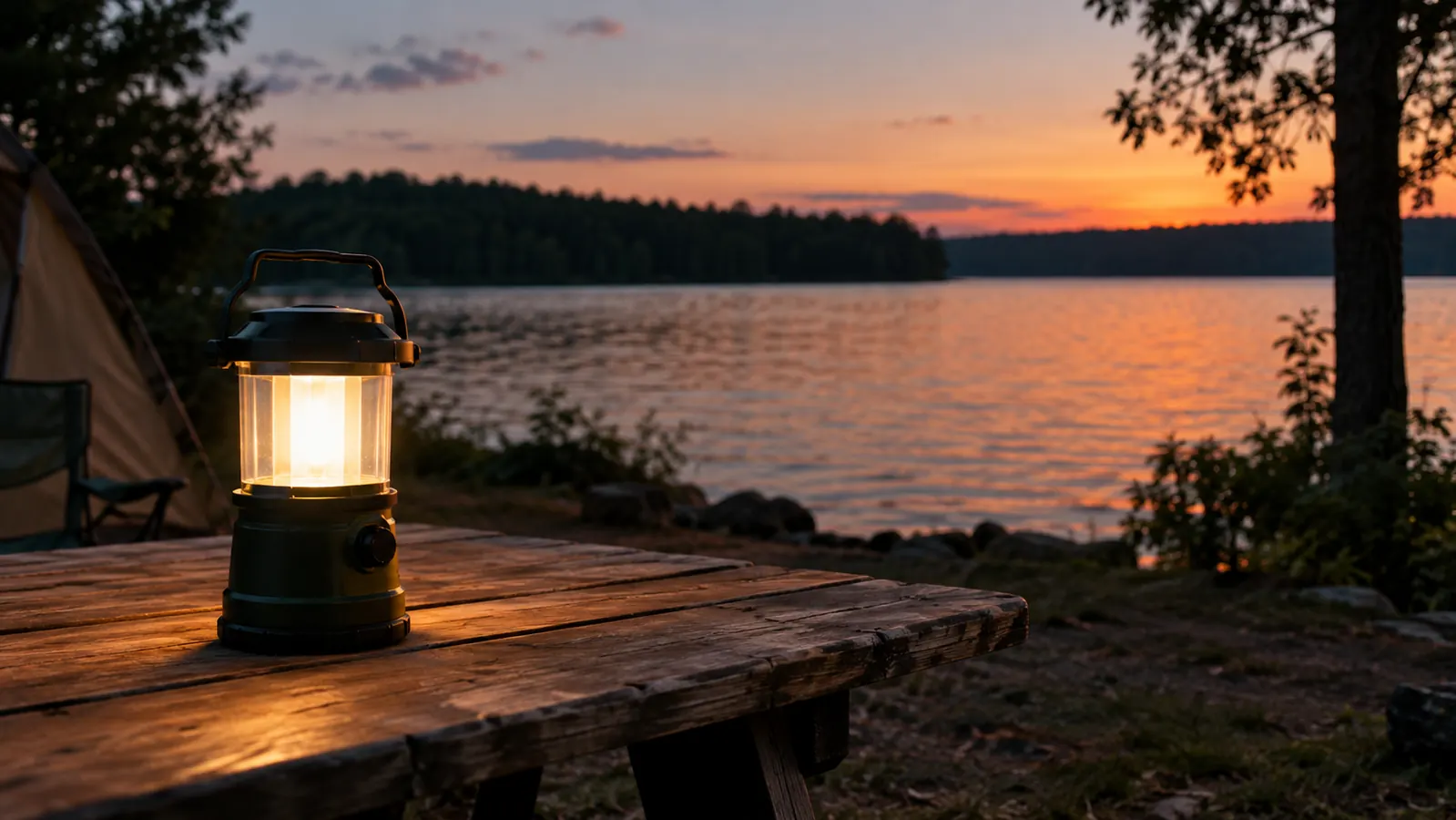
The first time I used the Energizer X1000, we pulled into a site at Clinton Lake after dark. Not late by most standards, but in late October the sun is down by six and a state park campground gets dark in a hurry. I was still unpacking the bed of the Tacoma while Marla stood at the picnic table with a headlamp that had been dimming for two seasons. I set the lantern on the table, clicked it once, and the whole site lit up. She didn't say anything. She just turned the headlamp off and sat down.
That was the beginning of a full season with it. Since then it has been to Perry Lake, down to the Lake of the Ozarks, over to Mark Twain National Forest, and out west for a week in Colorado. It sat through a thunderstorm, got knocked off a table twice, and spent the whole winter under the cap of my pickup. I have opinions, and here they are.
The Quick Verdict
The Energizer X1000 is the lantern I grab first on every trip. It is bright, simple, and tough, and one set of batteries carries us through a full weekend. It is not rechargeable and it is not a spotlight, and for table and tent duty that turns out to be fine.
Amazon Check Today's Price →The lantern that ended our headlamp era
After a full season of dark campgrounds, this is the light that stays on the picnic table from April to October.
Amazon Check Today's Price on Amazon →How I've Used It
I'm a retired HVAC technician. Thirty years of crawl spaces and attics gave me strong opinions about light, because half the job is trying to see what you're working on. Marla and I camp out of a 2014 Tacoma with a bed cap. No RV, no trailer. Just the truck, a cooler, and whatever fits behind the wheel wells. We go out most months from April through October, mostly at Clinton Lake and Perry Lake in Kansas and the Lake of the Ozarks in Missouri, plus one longer trip west every summer.
The X1000 was our main camp light for all of it. It sat on the picnic table at dinner, hung from the tent loop at night, and came along for the short walk to the vault toilets when neither of us wanted to carry a phone. I also left it in the truck all winter on purpose, because I wanted to know what a Kansas deep freeze would do to it. Nothing did. The first weekend I trusted it completely was the Friday after Memorial Day at Perry Lake. We rolled in after nine, the campground was full, and the lantern lit our whole corner of the loop while people three sites over were still fumbling with matches and mantles. That was the night I stopped treating it like a new gadget and started treating it like part of the campsite, the same way I trust my sleeping bag and my camp stove.
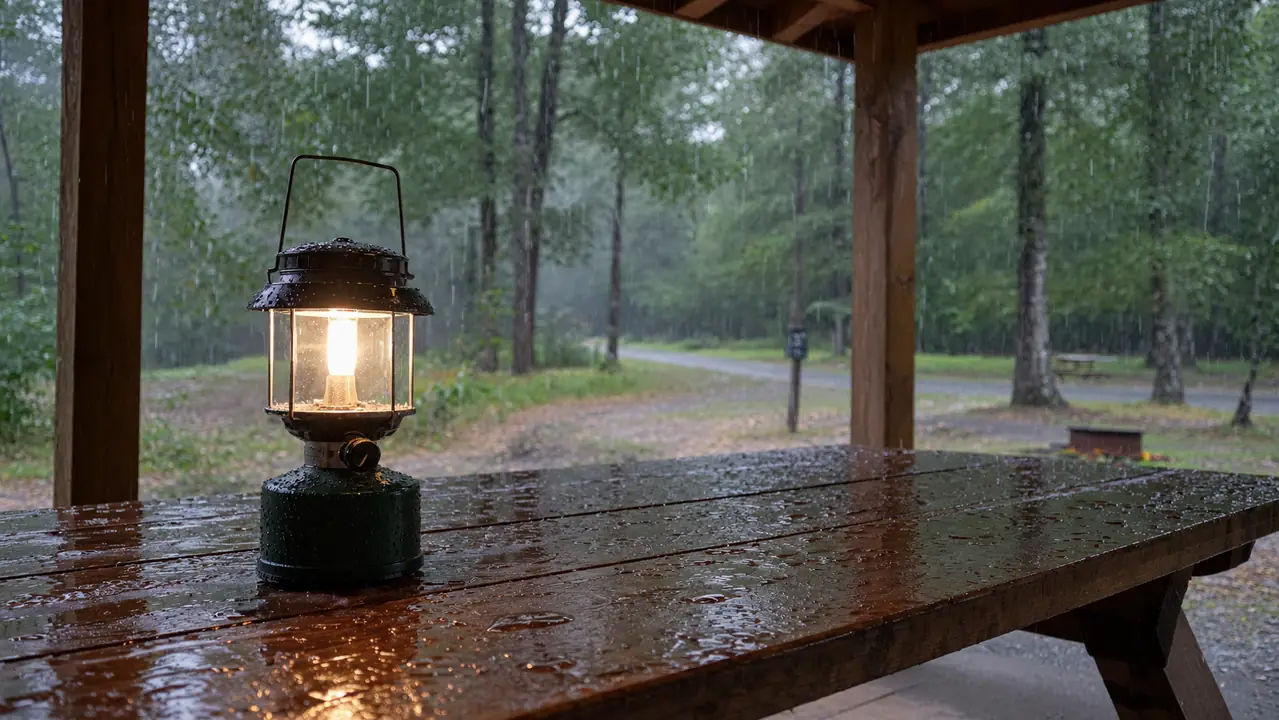
The rain test came in June at Mark Twain National Forest. A line of storms moved through around midnight and we sat in the tent with the lantern hanging from the center loop for a couple of hours. The tent fabric got damp, the lantern didn't. I don't leave it out in a downpour, but I stopped thinking about weather after that night.
Setting Up Camp in the Dark
Here is the routine that sold me. We get to a site late more often than we plan. Marla unlocks the bed cap, I hand her the lantern, she clicks it on and sets it on the table. Then we can actually unpack. Tent, bags, cooler, chairs, all of it happens in real light instead of the cone of a headlamp. In the old routine, whoever held the light couldn't help with anything, and whoever worked did it blind.
That one change, a lantern that lights the whole site instead of a spot, has taken the edge off every late arrival. It sounds small. It is not small when you have done it the other way for forty years.
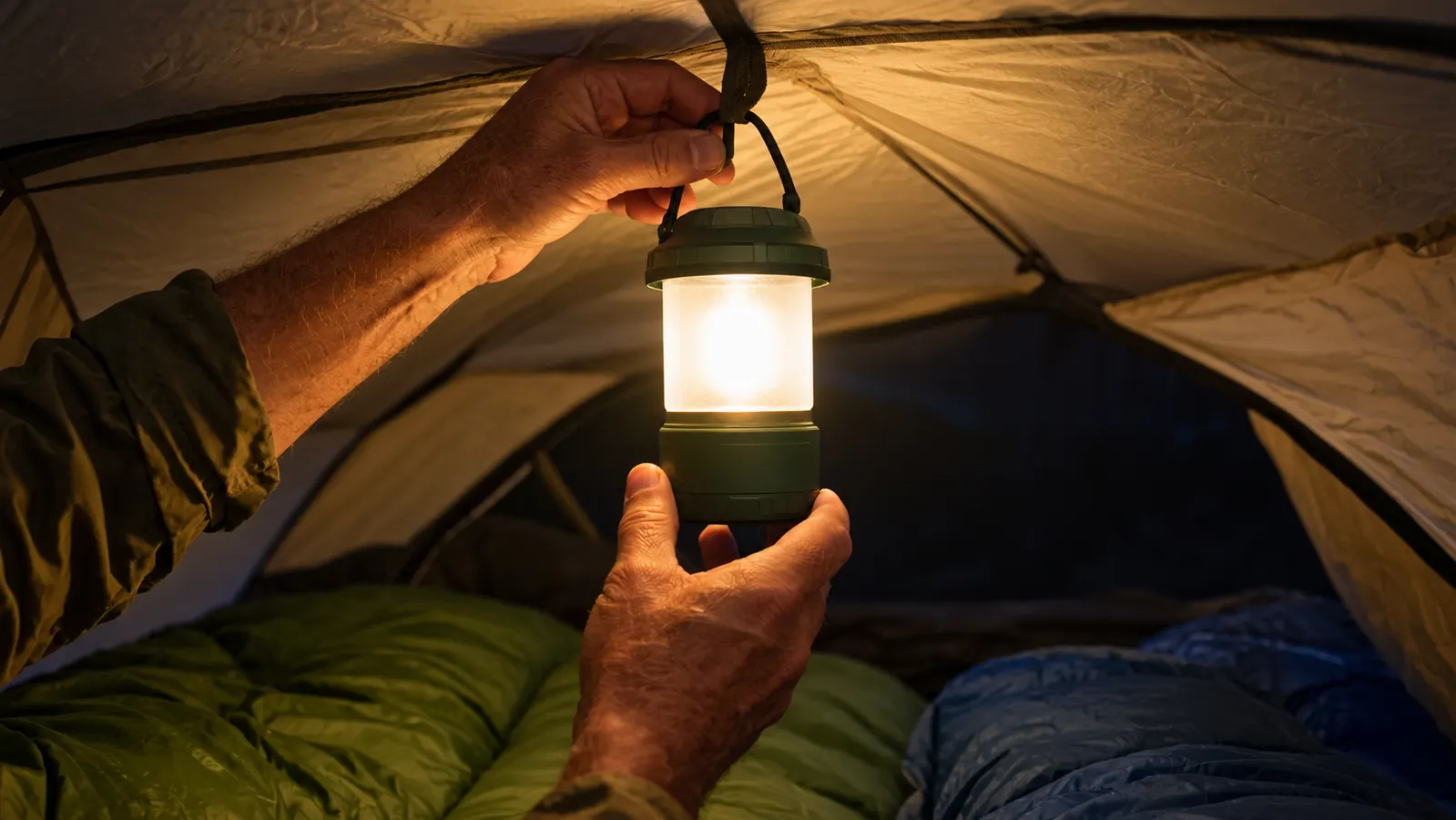
The hanging loop earns its keep, too. Inside the tent, I clip it to the center loop and we can both see to change clothes and find our spots in the sleeping bags. Then Marla reads, I turn it down to low, and it goes dark when she's done. No flashlight held in the teeth, no phone propped against a water bottle. It is the small stuff that makes a campsite feel like home, and light is at the top of that list.
The Light Is the Whole Story
The 1000 in the name is not decoration. On the high setting, this lantern lights the whole picnic table, the chairs around it, and the grill ten feet away. We have eaten dinner with six people and one lantern, and nobody needed their own light. That is the entire test, as far as I'm concerned. It is genuinely bright on high, bright enough that the table looks like a kitchen counter.
What surprised me is the spread. It throws light in a full circle instead of a beam, which is exactly what a lantern should do and a lot of them don't manage. Hang it from the center pole of the tent and you can read from either sleeping bag. A flashlight gives you one bright spot and a dark room. This gives you a room.
There are lower settings, and the low one is the one we actually use the most. Marla reads for an hour before she falls asleep, and the low setting is plenty for that without turning the tent into a gas station parking lot. The middle setting handles the picnic table. The high setting is for when you need to really see, like finding the bag of ice that slid under the cooler. One night at the Lake of the Ozarks, the stove ran out of propane halfway through cooking burgers and I had to finish on the campfire. The high setting lit the fire ring, the grill grate, and the plate in my hand all at once, which is a lot to ask from one light. In my twenties I ran a propane lantern that needed new mantles every other trip and a pump that leaked if you looked at it wrong. The X1000 replaced that whole ritual with one click.
Batteries, Cold, and the Practical Part
It runs on four D cells, and I want to be straight about what that means. You buy batteries, and batteries are not free. But we get a full weekend of evenings out of one set on the low and middle settings, and for a week long trip I pack one spare set and rarely break into it. We have gone through three sets of batteries in eight months of regular use, which tells you how little this lantern drinks. I track it the way I track furnace filters, by writing the date on the battery in marker. The first set went in on April 12 and came out on June 3. The second set covered the rest of the summer, including the Colorado trip. The third set went in during October and was still going when I parked the truck for winter. A four pack of D cells from the hardware store runs us about three months of weekends, and that is cheap insurance for light you never think about.
The cold did not touch it. It sat in the truck from November to March and fired right up on the first click in the spring. That is more than I can say for the rechargeable lantern I own, which drains itself sitting in a drawer between trips. A device that is dead when you reach for it is worse than a device that needs a battery.
Water resistant means what it says and nothing more. It has sat through light rain on the picnic table and never blinked. I would not leave it out in a storm or drop it in the lake. For tent and table duty, that is the right amount of waterproofing, and I have not missed having more.
One habit helps: I run the middle setting while we cook and drop it to low once we sit down to eat. The light is still plenty, and the batteries last noticeably longer. Runtime is not just about the lantern. It is about not running everything on high because you forgot there is a dial.
What It Won't Do
It is not a flashlight. It throws light everywhere, which is what you want on a picnic table, but if you need a tight beam to find the trailhead sign after dark, bring a headlamp. I keep one clipped to my jacket on every trip. The lantern and the headlamp are different tools and I use both.
It is not rechargeable, and I know that is the first question everyone asks. The Lepro rechargeable lantern is the most popular alternative and it is a good lantern. For my money, the simplicity of D cells beats remembering to charge one more device before a trip. We had a stretch in August where the weather was good three weekends in a row, and I never once checked the battery level before we left. With the rechargeable lantern, that check was part of the routine, same as keys and wallet. You cannot charge a lantern from a truck with a dead battery, but you can buy D cells at any gas station in Kansas.
It is also big. Not heavy, just bulky. It takes up a corner of the truck bed, and I keep it in a canvas bag with spare batteries behind the wheel well of the Tacoma. If you want a light that fits in a jacket pocket, this is not it.
How It Holds Up Over Time
I have knocked it off the picnic table twice. The first time was a windy night in September at Clinton Lake. A gust took the paper plates first, and then the lantern went over the edge, landed on packed dirt, rolled once, and came to rest against the cooler with the light still on. I picked it up, checked the lens, and put it straight back on the table. The second knock, later in the season, landed on the corner of a rock, and that is where the scuff on the base came from. I consider that character. The switch still clicks clean, the light is still even, and the handle is just as tight as the day it arrived. I have also dropped it once, carrying it from the table to the tent, and it landed on the handle with no damage.
The handle matters more than it sounds. You hang this from tent loops and tree branches, and you carry it by the handle from the table to the tent a dozen times a night. A weak handle would have shown itself by now. This one has not.
My only real complaint after a season of use is the switch. It is a simple push button and it has never failed, but I would like a firmer click so I know for certain it is off when I zip it into the bag. That is the entire list of complaints after eight months, which is a short list.
The Colorado trip was the longest stretch it worked without a break: nine nights straight, mostly at altitude, with cool nights every evening. It never flickered. A cheap lantern would have developed a loose connection by the end of a trip like that. The Energizer did not.
What I Liked
- Bright enough to light the whole table, with a true 360 degree spread
- A full weekend of evening use on one set of D cells
- Survived a Kansas winter in the truck bed and still fired right up
- Nothing to charge, nothing to pair, nothing to remember
- Water resistant enough for light rain and damp tent air
- Sturdy handle that hangs well from tent loops
Where It Falls Short
- D cells cost money over time, so it is not free to run
- No USB port, so you cannot top it off from the truck
- Bulky, not a pocket light
- The switch could click more positively
The whole test is whether the lantern lights the table well enough that nobody reaches for their phone. The Energizer X1000 passed that test on every single trip.
Who This Is For
If you camp out of a car, a truck, or a trailer, and you want one light that handles the table, the tent, and everything in between, this is it. It is for people who do not want to think about their light. Set it down, click it, it works.
It is also for anyone who has been burned by a rechargeable lantern that died at nine o'clock on the second night. D cells are sold at every gas station and grocery store in America. When our spare set ran low on a long weekend, the fix took one stop and two minutes. You cannot say that about a lantern that charges by USB.
Marla is the one who convinced me to write that down. She sleeps cold and she reads late, and the low setting on this lantern is the first camp light that has ever let her read without a headlamp. For her, that alone is worth the space in the truck.
Who Should Skip It
If you backpack, skip it. It is too big and D cells are heavy. A tiny USB lantern and a good headlamp will serve you better and weigh a quarter as much.
If you need a spotlight, skip it. If you want to light a trail or a boat ramp from fifty feet away, you need a real flashlight with a focused beam. This lantern throws a glow, not a beam, and that is not what it is for.
And if you are the kind of person who will never remember to keep batteries in a drawer, buy the rechargeable version instead. There is a reason those exist. This lantern assumes you can keep four D cells around, and if you cannot, it will be dead exactly when you need it.
Still the first thing in the truck bed
After a full season of dark campgrounds, this is the lantern that has not let me down once. If you camp where the lights end, this is the one to start with.
Amazon Check Today's Price on Amazon →