
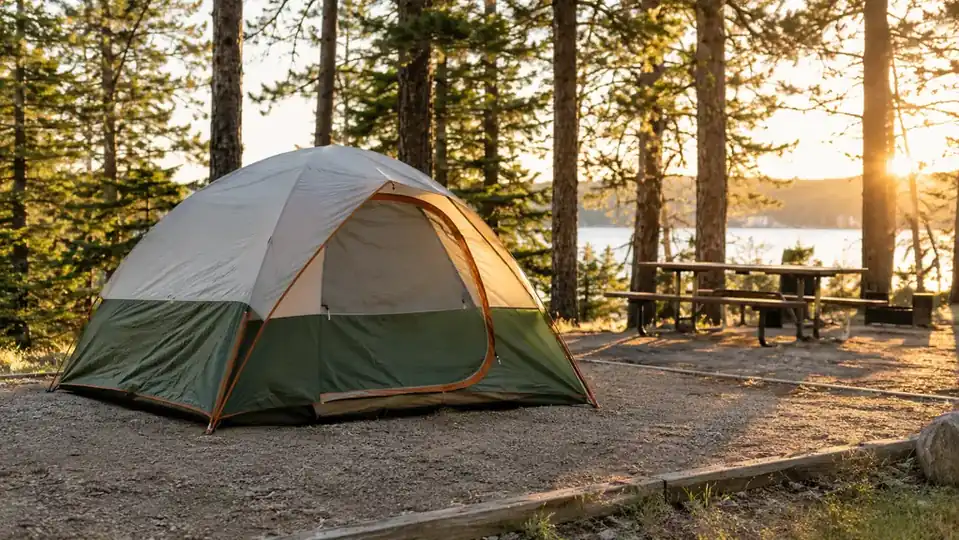
The first time Marla and I took the Coleman Sundome to Clinton Lake, we stood in the gravel parking spot staring at the bag like it was a test we had not studied for. Forty-five minutes later we had a tent that leaned east, a pole bag that had rolled under the truck, and supper that had gone cold. She was not mad at me exactly, but she was not speaking to me either. That was the trip I decided we were going to learn to do this in a straight line, and we have done it that way ever since.
This is the routine we use now at state park campsites from Perry Lake to the Ozarks. It takes about twelve minutes from the time I shut off the Tacoma until the rainfly is on. It works because every step has a reason, and because neither of us is standing around holding something while the other one guesses.
Start with a tent that goes up the same way every time
The Coleman Sundome is the tent we've used for most of our trips over the past few seasons. It's simple, it's dry, and the setup routine below assumes you're working with one.
Amazon Check Today's Price on Amazon →Step 1: Pick the spot before you unpack anything
Do this with the truck still running if you want to. Walk the campsite pad and look for three things: level ground, good drainage, and no dead branches overhead. Level matters more than people think. A tent that slopes two inches from head to foot is a tent you will slide down all night. Drainage matters because a low spot in the pad turns into a puddle under the floor when the evening thunderstorm rolls through.
State park pads are usually gravel or packed dirt, and they are usually graded well enough that you can find a level spot by eye. If the pad is tilted, face the tent so your head will be uphill when you sleep. That one decision saves more arguments than any other step in this list.
Clear the pad of pine cones, rocks and sticks before you lay anything down. A rock the size of a walnut under the floor will find your hip at 2 a.m. It always does.
Step 2: Lay out the footprint or ground cloth first
If you bought the footprint that matches the Sundome, lay it down with the printed side up and the bungee loops facing the corners. If you are using a plain tarp, fold it so it is an inch or two smaller than the tent floor on every side. A tarp that sticks out past the floor catches rainwater and channels it under the tent, which is exactly backwards from what you want.
Smooth the ground cloth flat and stake the corners. This does two things: it keeps the cloth from bunching up when you walk on it, and it marks the four corners so you know exactly where the tent is going to sit. If the wind picks up while you are setting up, the ground cloth keeps the tent from becoming a sail before it is staked.
Step 3: Spread the tent out and stake the four corners
Take the tent out of the bag and lay it flat on the ground cloth with the door where you want it. This is the moment to think about the door. Face it away from the prevailing wind if you can, and toward the picnic table if you cannot decide otherwise. Marla and I both want the door facing the view, and we have learned to settle that before the tent is up rather than after.
Push a stake through each corner loop at a 45 degree angle, pointed away from the tent. A stake driven straight down pulls out in soft ground. One driven at an angle holds like a hook. Tap it in with your boot heel or a rubber mallet, but leave the head of the stake above the dirt so you can pull it out on Sunday morning.
Staking the corners before you insert the poles is the step most people skip, and it is the reason so many tents look like they are melting. The floor has to be held down before the poles go up, or the poles pull the floor toward the center and the whole tent wrinkles.
Step 4: Thread the poles and raise the dome
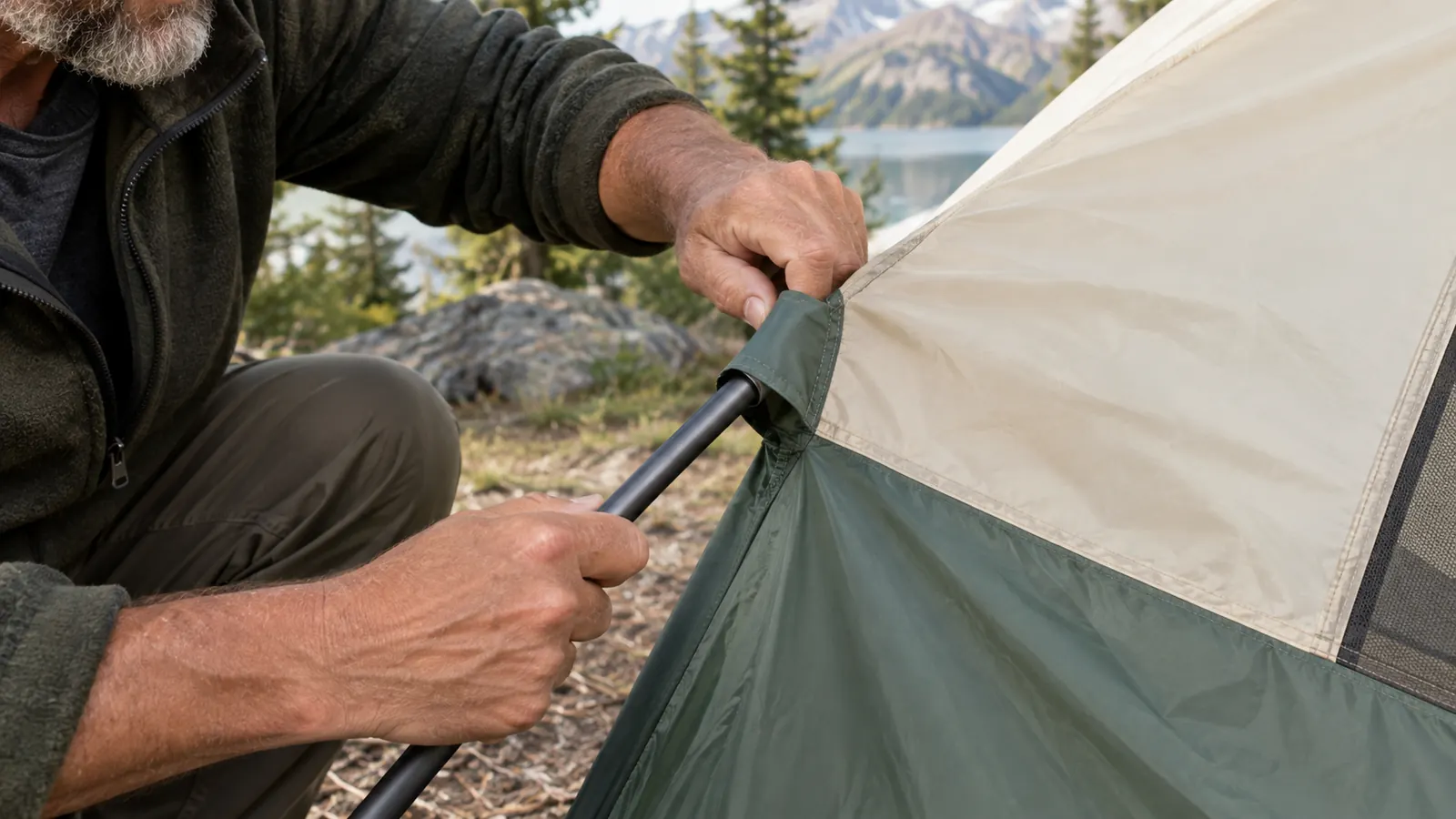
The Sundome uses two poles that cross over the top. Feed the first pole through the sleeve on one side, starting at the grommet by the door. Push, do not pull. If the pole hangs up, back it out an inch and feed it again rather than forcing it through the fabric. Pulling a pole through a sleeve is how sleeves tear.
Seat both ends of the first pole in the corner grommets, then do the second pole the same way on the other side. Here is the part that makes the whole thing easy: Marla takes one corner and I take the opposite corner, and we lift at the same time. The dome comes up square, and neither of us is fighting the other person's side.
Once the dome is up, snap the pole clips over the poles and adjust the corner stakes if the tent has shifted. The tent should stand on its own now. If it sags on one side, check that both pole ends are fully seated in their grommets. That is the cause of nine out of ten sags.
Step 5: Put the rainfly on, stake the guy lines, and check the seals
The rainfly is the part people skip when the sky is blue, and it is the part that saves the trip when the sky is not. Drape the fly over the dome with the buckles at the corners, clip it down, and hook the front and back loops over the pole ends. Then stake the four corners of the fly out so there is an air gap between the fly and the tent body. That gap is what keeps the inside dry: it lets condensation run down the inside of the fly instead of dripping on your sleeping bag.
Tighten the guy lines on the windy corners. The Sundome has guy loops near the top of the fly on each side. Stake them out in a straight line from the tent, not angled back under it, so they actually hold against the wind. On gusty nights at Perry Lake, the guy lines are the difference between a tent that hums and a tent that flaps hard enough to wake you up.
Last thing: unzip the door and check the seams along the floor and the corners from the inside. A Coleman tent from the factory is usually sealed fine, but a seam can get snagged in transit or the previous trip. If you see daylight through a stitch hole, that is the spot to hit with seam sealer when you get home. Knowing it now beats discovering it at midnight in the rain.
What Else Helps
A few things make the routine go faster and the night go better. Keep a small toolbox in the truck bed with a rubber mallet, a handful of extra stakes, and a headlamp for each of you. Set a rule that the tent goes up before the chairs come out, because chairs and coolers spread across the pad and turn setup into an obstacle course. And if you are on a gravel pad, bring a ground cloth even when the forecast is dry; it keeps the floor clean and adds a layer of insulation against the cold ground.
Two more habits from our trips. First, put the rainfly on even on clear nights. The dew at Clinton Lake soaks a tent without a fly by morning, and nobody wants to pack a wet tent into the Tacoma. Second, do a five-minute walk around the tent before dark. Check the stakes, check the guy lines, and make sure the door zipper closes smoothly from both sides. Fixing a zipper in the daylight takes two minutes. Fixing it in the dark takes forty.
The whole setup is twelve minutes when we do it in order: spot, ground cloth, corners, poles, fly. Every step has a reason, and the reasons are what stop the arguing.
Why We Set Up the Same Way Every Time
The reason we settled on this exact order is that it never makes us redo work. Pick the spot first, so the tent is not uphill from the picnic table. Ground cloth first, so the tent floor is not sitting on gravel. Corners staked before the poles go in, so the floor stays flat. Fly last, so the poles are not fighting the fabric while you are trying to align the buckles.
I worked HVAC for thirty years, and the worst service calls were the ones where someone had skipped a step and then tried to force the next one. Tents work the same way. The Coleman Sundome is forgiving enough that you can set it up out of order and still end up with a usable tent, but you will end up with wrinkles, a sagging door, or a fly that does not quite reach the corners.
The other thing that keeps the peace is having defined jobs. Marla handles the far corner and the rainfly buckles. I handle the poles and the stakes. Neither of us is giving directions to the other person's job, which is the part that actually caused the arguing on that first trip.
What the Coleman Sundome Does Well on a State Park Pad
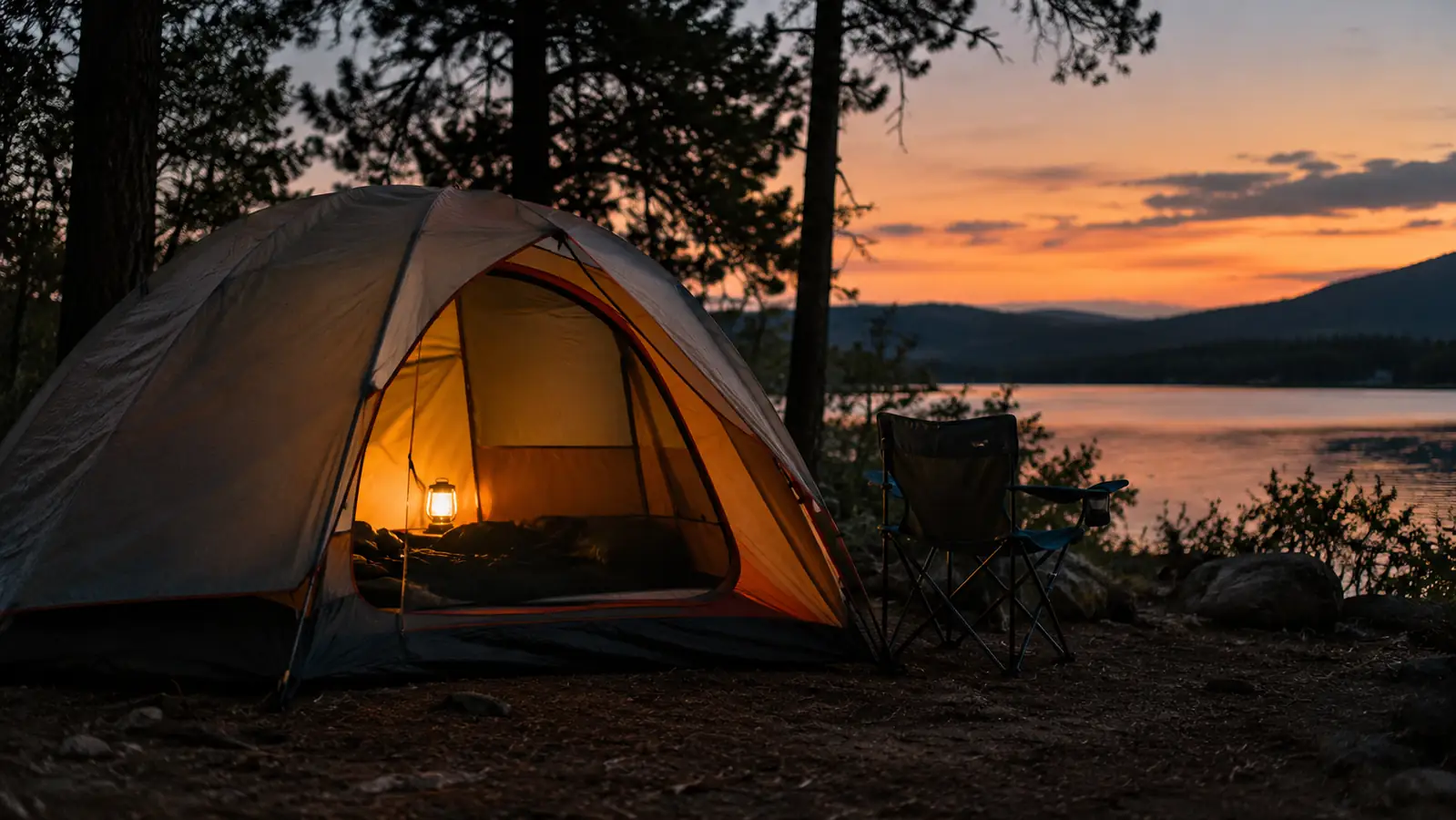
The Sundome is not the lightest tent and it is not the most rugged tent. It is the tent that makes sense for car camping at a state park. The poles are continuous fiberglass sleeves, which means there are no loose parts to lose in the grass. The door is a D-shaped zipper door that is easy to get in and out of at night. The rainfly covers the top and comes down far enough to keep wind-driven rain off the upper walls.
The Coleman brand has been making this same basic dome for decades, and that consistency is the point. When we bought our second Sundome for the kids to use at Lake of the Ozarks, the setup was identical to the one we already had. No new instructions to study, no different pole lengths to sort out. That is worth a lot when you are setting up in the dark after a long drive.
We have had the Sundome out in a heavy thunderstorm at Mark Twain National Forest and stayed dry. We have had it in wind at Perry Lake where the fly snapped all night and the tent held. It is not a four-season mountaineering tent. It is a solid, dry, easy-to-set-up shelter for the kind of camping most of us actually do, which is driving to a state park, sleeping on a pad, and cooking breakfast on a camp stove.
Who This Routine Is For
This routine is for anyone who camps out of a car or a truck, which means most of the people at a state park campground. If you are backpacking, you will not be carrying the Sundome and you will not be staking out a rainfly with extra guy lines. If you are camping in a pop-up or an RV, you do not need any of this. But if you are like us, and your whole camp setup comes out of the bed of a Tacoma, this is the fastest way we have found to get from parking to sitting by the fire.
It is also for anyone who has ever stood in a campground with a tent bag open and felt the other person's patience running out. The routine takes the guesswork out, and the guesswork is what causes the arguing. When each step has a reason, nobody has to be the boss.
Give yourself a tent you can trust in the dark
If you are shopping for a tent for state park camping, the Coleman Sundome is the one we keep coming back to. Simple poles, a dry rainfly, and a setup you can do in the dark after a long drive.
Amazon Check Today's Price on Amazon →