
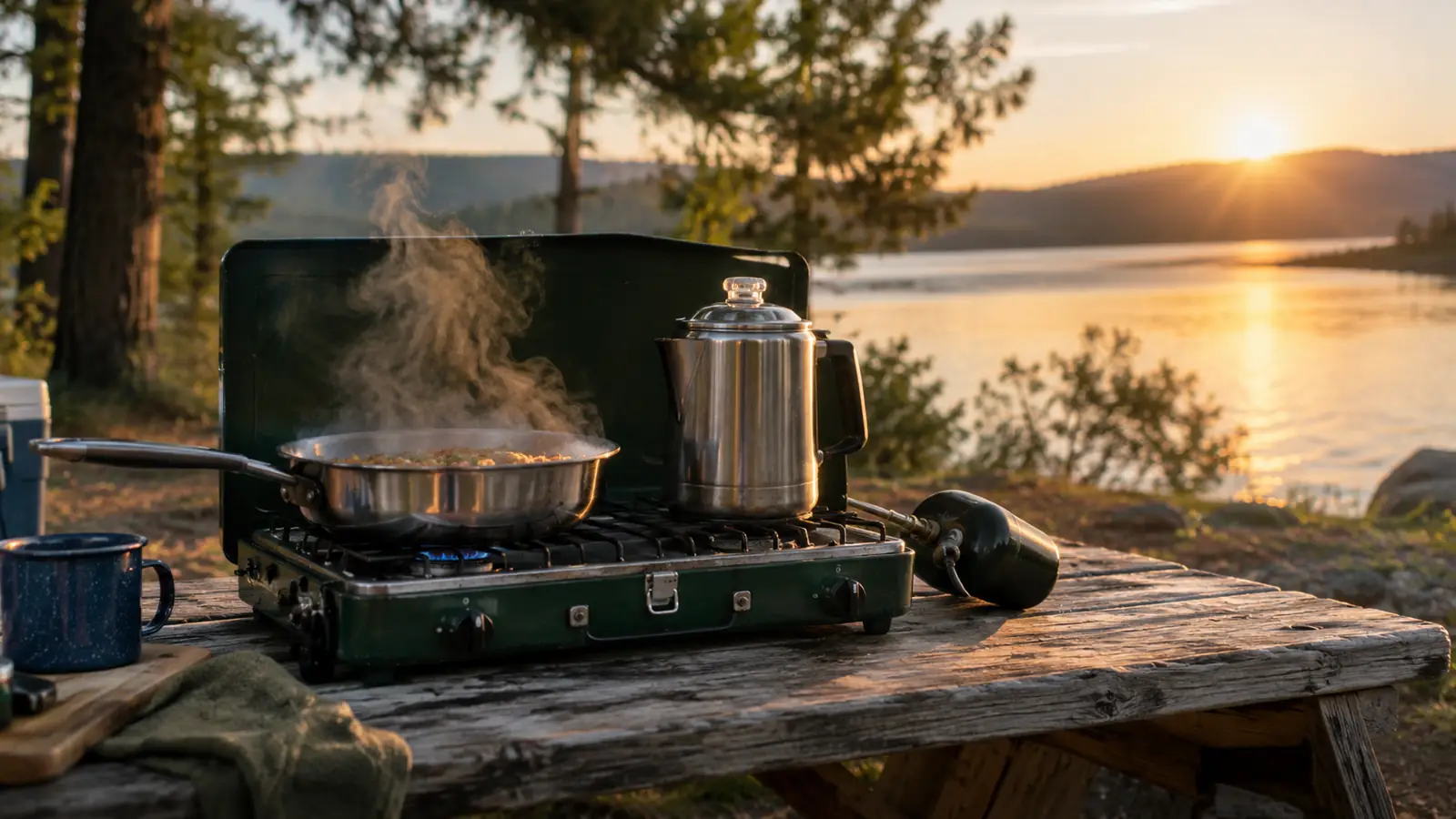
I spent thirty-seven years working on furnaces, water heaters, and gas valves before I retired, so I tend to look at a camp stove differently than most folks. I look at how the flame sits on the burner. I look at whether the valve will hold a low setting without drifting overnight. And I look at how the stove behaves when the wind comes up off the lake, because wind is where cheap stoves show themselves. This is the honest review of the Coleman Triton stove that nobody puts on the box. Marla and I have cooked on ours every trip since April of last year, which adds up to Perry Lake, Clinton Lake, Lake of the Ozarks, Mark Twain National Forest, and one long week in Colorado.
Some of what I have to say is good, and some of it is the kind of thing you only learn after a dozen mornings of cooking bacon in the wind. I am not going to tell you the Triton is the last stove you will ever buy, because that is not true. I am not going to tell you it is perfect, because it is not. I am going to tell you what it does well, what it does poorly, and what I would do differently if I were buying again tomorrow.
The Quick Verdict
A steady, powerful two-burner stove for car campers who cook real meals, held back by a fuel gauge that lies and a wind block that only works in a breeze.
Amazon Check Today's Price →The two-burner stove we cooked on all season
Six months of weekend trips, from a cold April morning at Perry Lake to a fish fry at Lake of the Ozarks, and the Coleman Triton still starts on the first or second click. See today's price on Amazon.
Amazon Check Today's Price on Amazon →How I've Used It
Marla and I car camp out of a 2014 Tacoma with a bed cap, so we are not backpacking. We are cooking breakfast, lunch, and most dinners at a picnic table, and the stove lives on that table from the moment we set up until the moment we pack out. The Triton has been that stove since April. Our first trip was to Perry Lake in Kansas, a cold weekend where the wind never really quit. We made bacon, eggs, and a pot of percolator coffee before the sun was fully up. The coffee was ready before the bacon, which is the order Marla prefers, and the stove did the whole job without complaint.
Since then it has cooked a lot of meals. Hash browns at Clinton Lake on a June morning so humid the pan sweat. A fish fry at Lake of the Ozarks with a twelve-inch cast iron skillet packed to the rim, where the rear burner held the oil at a steady bubble while the front burner finished the hush puppies. Pancakes at Mark Twain National Forest on a morning so foggy the griddle needed two towels. It has also been rained on once, when we misjudged a storm, and it dried out and worked fine the next morning. That is more than I can say for the old single burner we replaced, which quit twice on the same trip to Colorado two years ago.
The two burners sit far enough apart that a twelve-inch skillet and a percolator fit at the same time without crowding, and that spacing is the whole reason we bought it. The legs adjust, which matters more than you think, because park picnic tables are never level. The whole thing folds into a case about the size of a small suitcase and rides in the bed cap without complaint. That is the honest description of how we use it, and it is the context for everything else in this review.
What Nobody Tells You About the Fuel Gauge
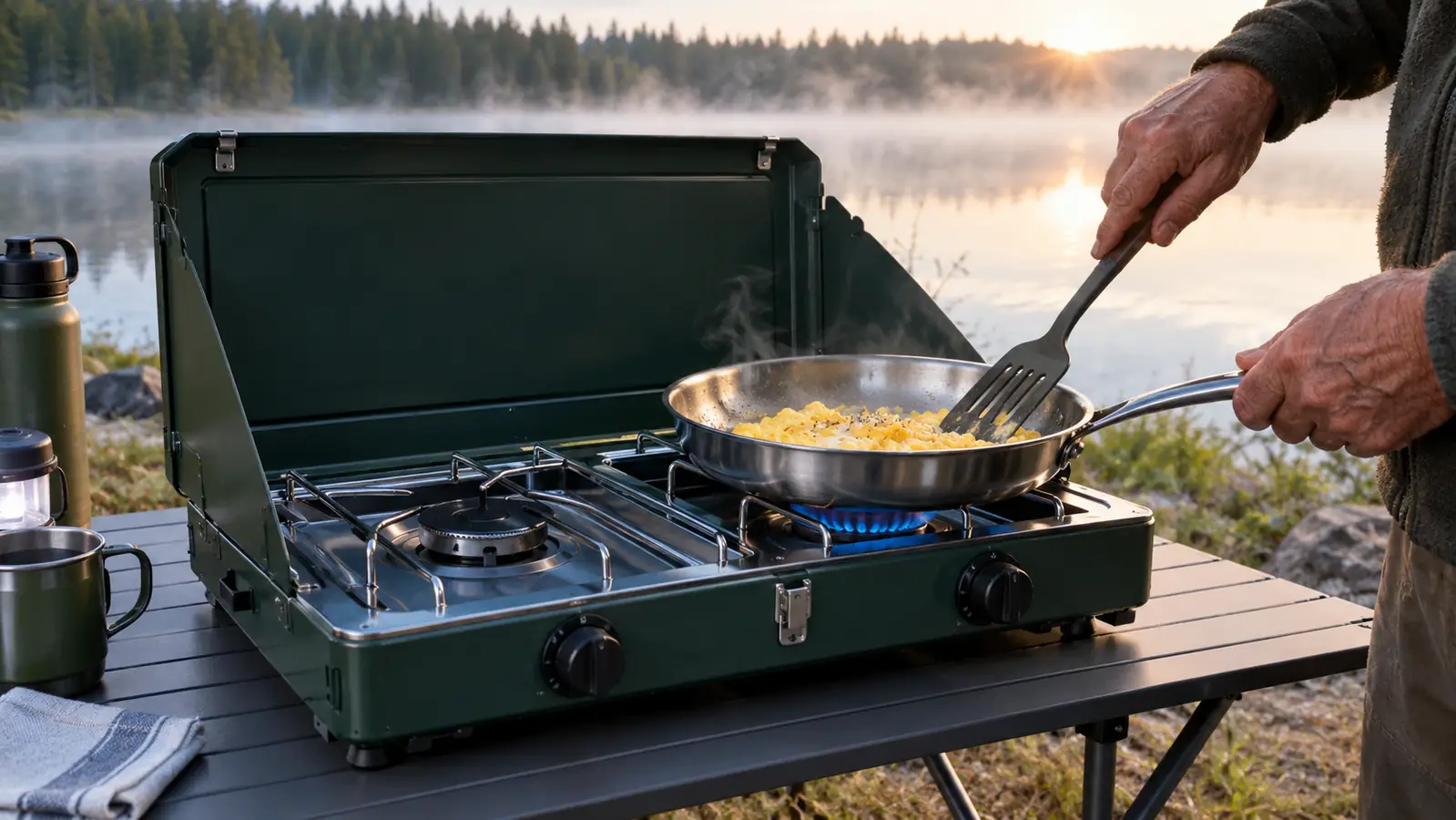
Here is the first thing nobody tells you about the Coleman Triton: the fuel gauge window on the side of the stove is a suggestion, not a measurement. It is supposed to show how much propane is left in the small bottle. In my experience, it reads high when the bottle is cold, low when the bottle is warm, and wrong most of the time in between. A manometer would tell you the truth. This window tells you a story, and the story is usually optimistic.
I learned this the hard way at Clinton Lake in October. The gauge read half full when I started breakfast, so I left the spare bottle in the truck. Halfway through scrambling eggs, the flame shrank to a whisper and then went out. The eggs finished in the residual heat of the pan, and Marla ate lukewarm eggs that morning while I walked to the truck for the spare. The gauge still read about a quarter full when the bottle was empty. I have not trusted it since, and I would not trust one in a store either.
What works instead is boring and simple. Bring a spare sixteen-ounce bottle, and swap when the flame starts to shrink, not when the gauge says you are low. A full bottle runs the Triton for about an hour of cooking on high, longer once you drop to a simmer. I do not track it to the minute. I keep two bottles in a plastic bin in the bed cap, and I have never been caught short since I started doing that. The gauge is the feature you will learn to ignore.
Flame Control and the Simmer Problem
The second thing nobody tells you is that the Triton has a learning curve on the low end. The knobs sweep smoothly from high to low, but the useful simmer zone is a narrow band right before the flame wants to go out. On our first trip, I scorched pancakes because I assumed the knob would behave like the one on our kitchen range. It does not. The low end is finicky until you find the spot, and you will lose the spot again if you bump the knob while you reach for the syrup.
Once you learn the stove, though, it is genuinely good at low heat. The Triton will hold a pot of beans at a lazy bubble for an hour without scorching the bottom. It will keep gravy warm while biscuits finish in the dutch oven next to the fire. That matters to us because we cook real meals, not just boil water for pouches. The high end is strong too. Twenty thousand BTUs across the two burners gets a twelve-inch skillet of bacon going fast, and it will boil water for coffee in about the same time the old single burner took to do half as much.
The push-button ignition is convenient but not perfect. On a cold morning it sometimes takes two or three clicks before the burner lights, and I have had mornings where I clicked five times and then reached for the lighter I keep in the kitchen box. That lighter is now a permanent part of the kit. If the piezo ever dies completely, the stove still works with a match, because the gas valve is simple and mechanical. There is no circuit board in this stove, which is exactly what I want from a piece of camping gear.
Wind: The Stove's Real Weakness
The third thing nobody tells you is that the wind block on the Triton is shorter than it looks in the product photos. It wraps around the sides and the back of the stove, and it does a fine job in a light breeze. In real wind, the kind that comes up off a lake in the late afternoon, it is not enough. The flame flickers, the pan heats unevenly, and a hard gust can push the flame sideways under the pan and scorch one edge of whatever you are cooking.
We found this out at Perry Lake in April. The morning was calm and the stove did fine. By supper the wind had picked up, and the beans on the rear burner were barely bubbling while the front burner cooked fine. I tried turning the whole table to face the wind, which helped a little, because the solid back block took the brunt of it. The real fix was a folding windscreen we set up on the open side. It is a three-sided aluminum screen, the kind you see at every flea market in Kansas, and it cost less than the propane we burned that weekend.
So here is the honest advice: plan on buying a windscreen, or at least orient the stove so the back block faces the wind. The Triton is not a stove that fails in wind. It is a stove that needs a little help in wind, and nobody tells you that in the listing. If I were reviewing the stove for a friend, this would be the first thing I mentioned, right ahead of the fuel gauge.
Cold Weather and Propane Vapor Pressure
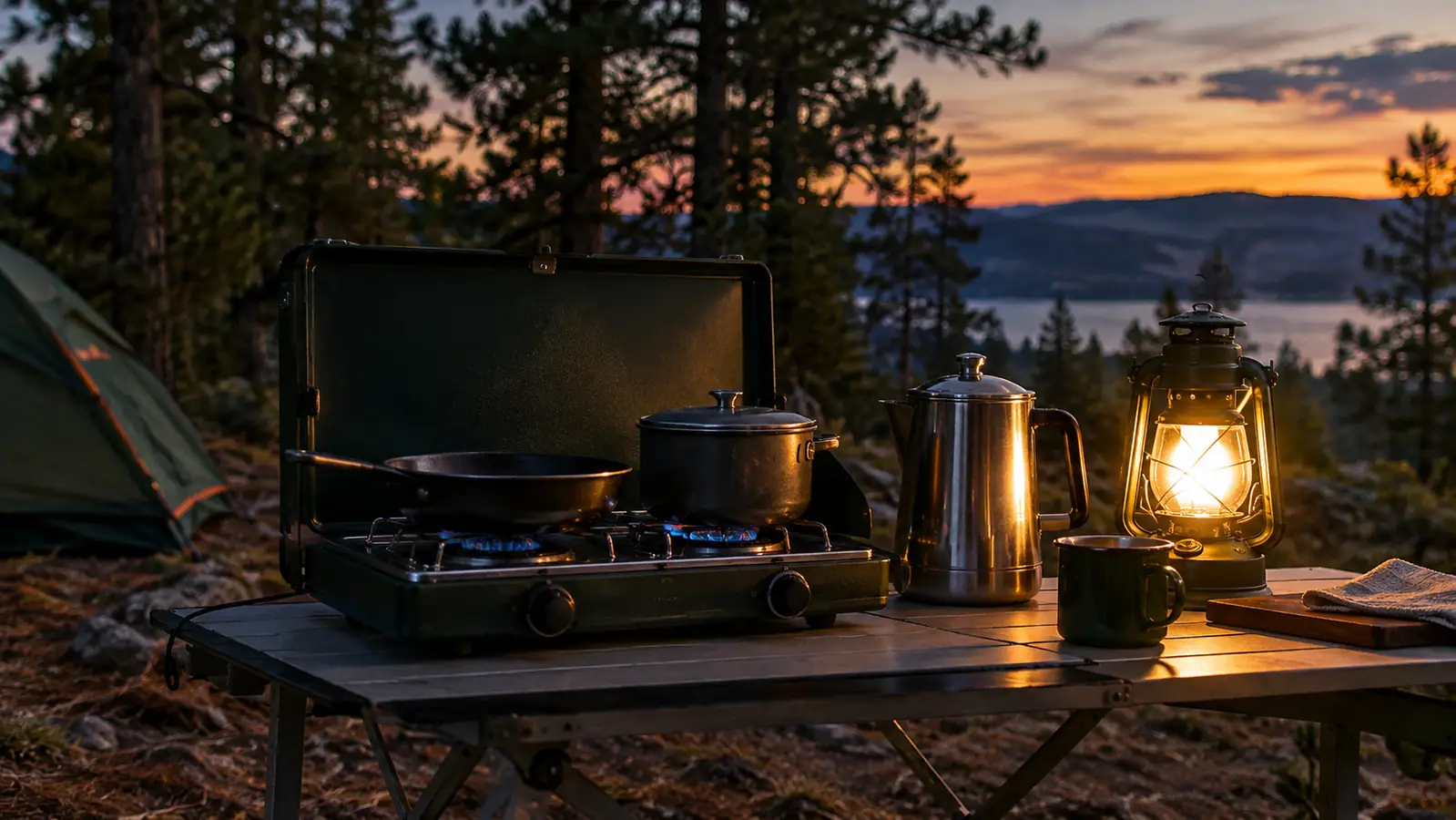
This next part is the HVAC tech in me talking. Propane vaporizes at forty-four degrees below zero, which sounds like the perfect cold weather fuel. The catch is that the small bottles cool themselves as they release gas. On a thirty-two degree morning at Clinton Lake, the bottle was frosting over within ten minutes, and the flame was visibly weaker by the time the coffee was done. The stove was fine. The bottle was the bottleneck, and no amount of stove will fix a bottle that cannot keep pressure.
The fix for cold weather is to keep the bottle off the frozen ground and out of direct wind. A folded towel under the bottle helps. So does holding the bottle in your hand for a minute before you screw it on, which warms the liquid and raises the pressure. The bigger fix is to run the Triton off a twenty-pound tank with an adapter hose that you buy separately. A twenty-pound tank has enough surface area to keep pressure up in weather that starves the little bottles. I have done both, and the adapter hose is the better answer for late-season trips. It is also less trash, because you are not throwing away a bottle every couple of days.
Altitude is a separate thing. We spent a week in Colorado last summer, camped around eight thousand feet, and the stove worked fine but the flames looked different and the output felt softer than at home. That is normal. At altitude there is less oxygen, so combustion is different, and everything takes a little longer. I mention it because a lot of people assume the stove is broken when it is just working in thinner air. Give it more time and it will get the water to a boil.
The Little Things That Bother Me After Six Months
Now the small stuff. The chrome grates discolor after a few hard uses. It is cosmetic, it does not affect cooking, but if you like gear to look new forever, this stove will disappoint you. The latch on the case is plastic and feels lighter than I would like. Ours still works after six months, but I close it gently. The drip tray catches grease, and you have to clean it or the next trip starts with the smell of old oil.
The stove connects directly to the small propane bottle, so there is no hose to lose, which I count as a good thing. It also means the bottle hangs off the side of the stove, and on an uneven table you have to be careful the bottle does not tip. The stove hisses when it runs. It is not loud, but on a quiet night at Perry Lake you will notice it. None of these are deal breakers. They are the honest details that reviews usually skip, and they are the reason this review exists.
One more thing. The knobs are not marked with any kind of detent, so you cannot set the same flame twice without looking. In practice I have learned where the simmer spot is by feel, the way I learned the valves on a furnace. But for the first few trips, I found myself standing over the stove with a spatula in one hand and the knob in the other, adjusting every few minutes.
What I Liked
- Steady, controllable flame once you find the low-end sweet spot
- Enough output for a twelve-inch skillet and a percolator at the same time
- Matchless ignition saves matches on most mornings
- Adjustable legs and a folding case make it easy to live with
- Simple mechanical gas valve, easy to understand and easy to work on
Where It Falls Short
- Fuel gauge window is unreliable
- Wind block is too short for real lake gusts
- Chrome grates discolor within a few trips
- Only takes small propane bottles unless you buy an adapter hose
- Ignition sometimes needs several clicks
The fuel gauge on the Coleman Triton is a suggestion, not a measurement. I learned that the hard way at Clinton Lake.
Who This Is For
Buy the Coleman Triton if you car camp, if you cook real meals at a picnic table, and if you want a stove you can find parts for in any hardware store. It suits a couple or a small family. It suits people who camp from April through October the way we do, who want two burners that both work, and who are willing to spend a trip or two learning where the simmer spot is. If that sounds like you, the Triton will be a good stove for a long time. Ours has earned its place in the Tacoma.
Who Should Skip It
Skip it if you backpack, because it is too heavy and too bulky for a pack. Skip it if you only boil water for coffee, because a single burner will do that with less to carry. Skip it if you refuse to carry a windscreen, because you will spend your trips fighting the wind. And skip it if you expect the fuel gauge to work like the gauge in your truck. It is not that gauge. It is a window with a float in it, and it lies. Buy the stove for the burners, not for the window.
The honest bottom line on the Coleman Triton
After six months of trips, the Triton is the stove that rides in the Tacoma every time. The fuel gauge will test your patience and the wind block needs help, but the stove itself cooks. Check today's price on Amazon.
Amazon Check Today's Price on Amazon →