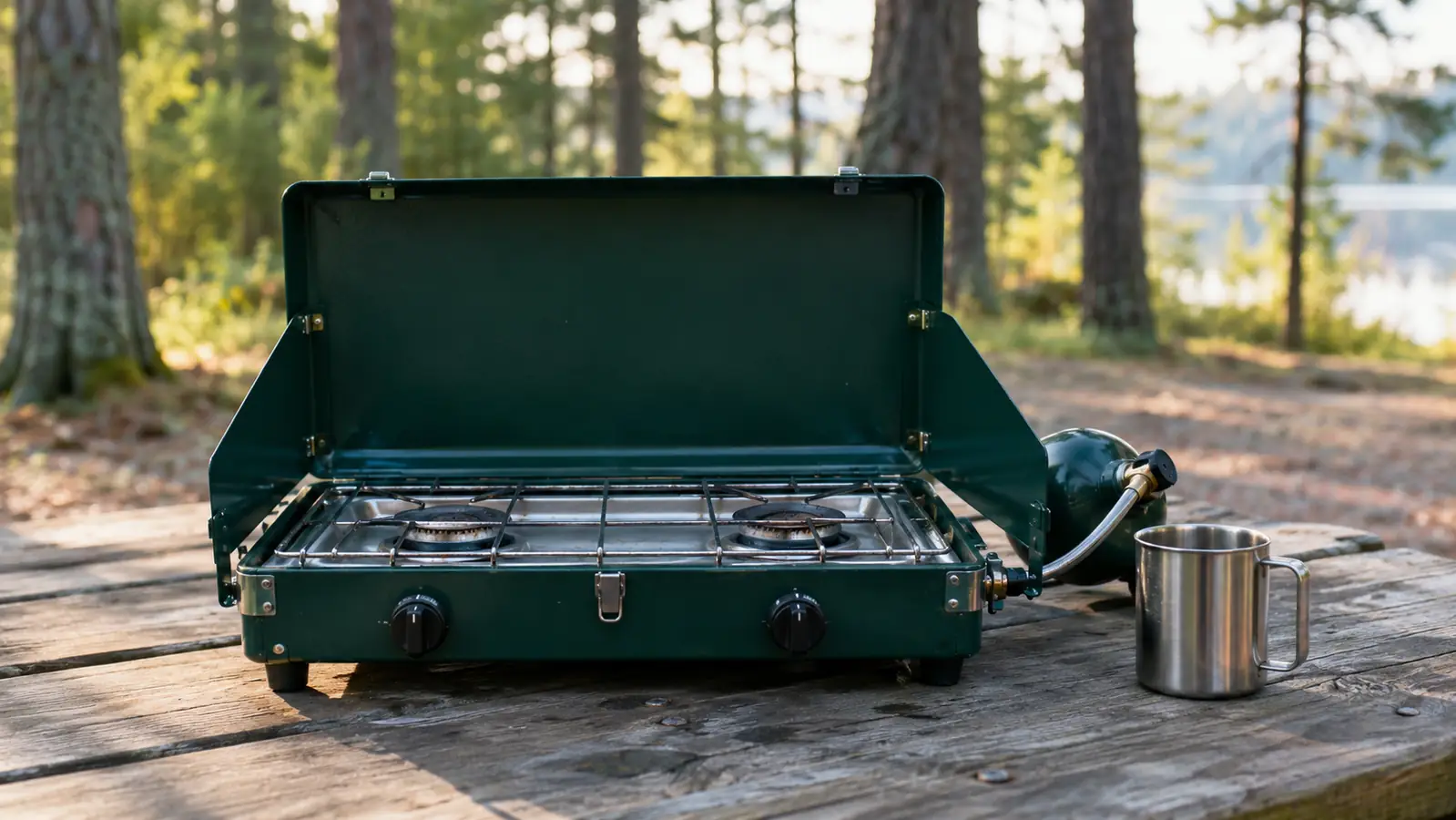
I cooked breakfast on the Coleman Triton nearly every camping trip last season. That is about 14 trips between April and October, most of them at Clinton Lake and Perry Lake here in Kansas, a few down at Lake of the Ozarks, and one long week in Colorado. Marla and I eat eggs, bacon, and coffee at the campground table most mornings, and the stove sat on that table for all of it. I am a retired HVAC technician, so I notice how a burner sounds, how evenly it heats, and how long a tank lasts. The Coleman Triton did some things better than I expected and a couple of things I would change if I owned the design.
This is not a first-impression review. I bought the stove in April, used it through October, and I kept notes on what worked when the wind came up, when the mornings got cold, and when I just wanted breakfast done before the fishing boats got out. Here is what a full season of campground breakfasts taught me about the Coleman Triton.
The Quick Verdict
The Coleman Triton is the best two-burner propane stove I have used in 40 years of car camping. It boils water fast, handles wind better than most, and the folding design fits the bed of my Tacoma. It is not the lightest stove you can carry, and the griddle it comes with is not worth much, but for campground cooking it is hard to beat.
Amazon Check Today's Price →A full season of campground breakfasts, one stove
I used the Coleman Triton on 14 trips last season and it never let me down. If you cook real meals at the campground table, this is the stove I would buy again.
Amazon Check Today's Price on Amazon →How I've Used It
The Triton is a two-burner propane stove that runs off the standard 16.4-ounce green Coleman propane cylinders. I used it on the picnic table at every campsite, never on the ground. That matters because the wind guard works better when the stove is up off the grass, and because I am 59 years old and would rather not squat down to flip pancakes.
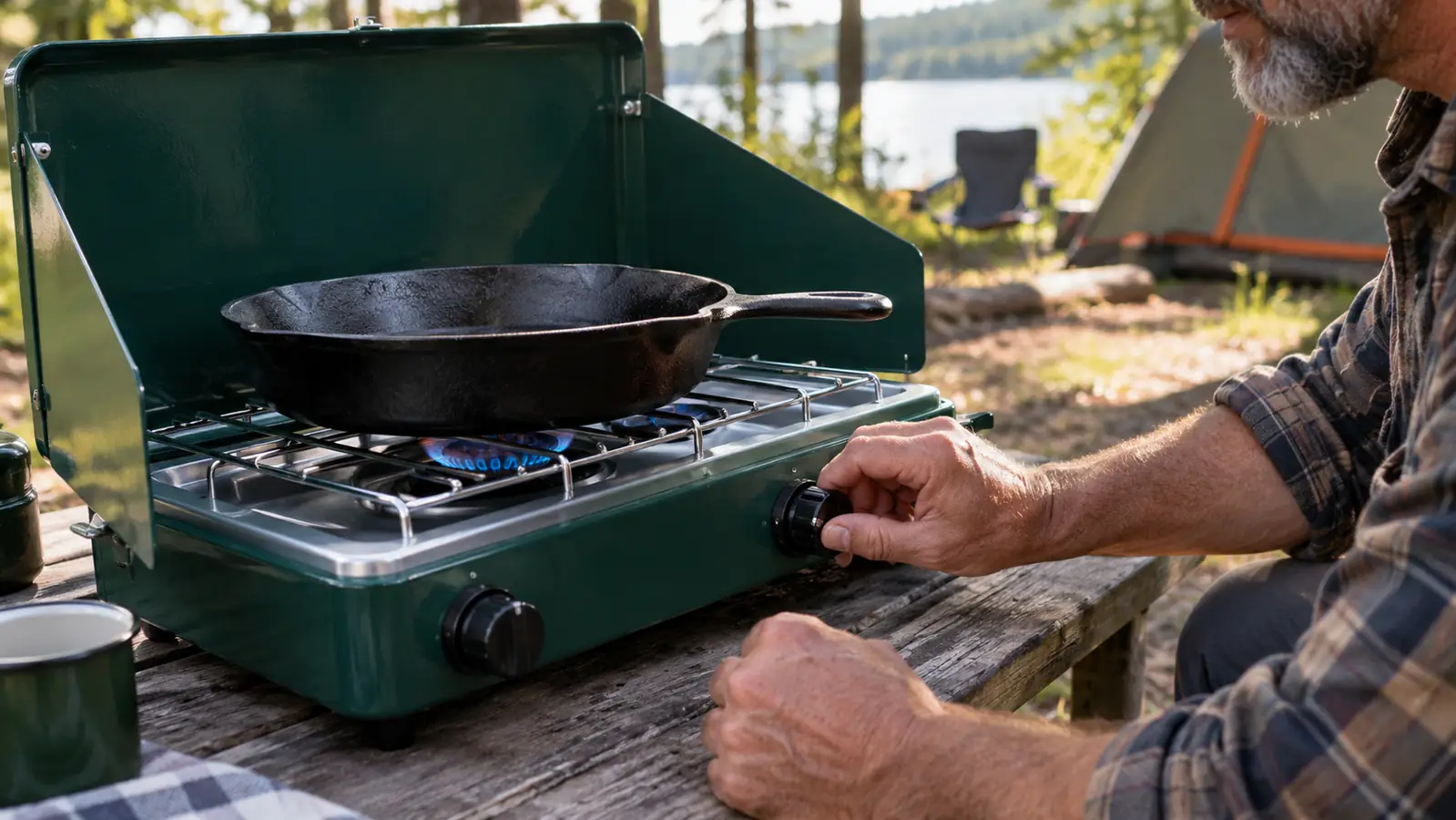
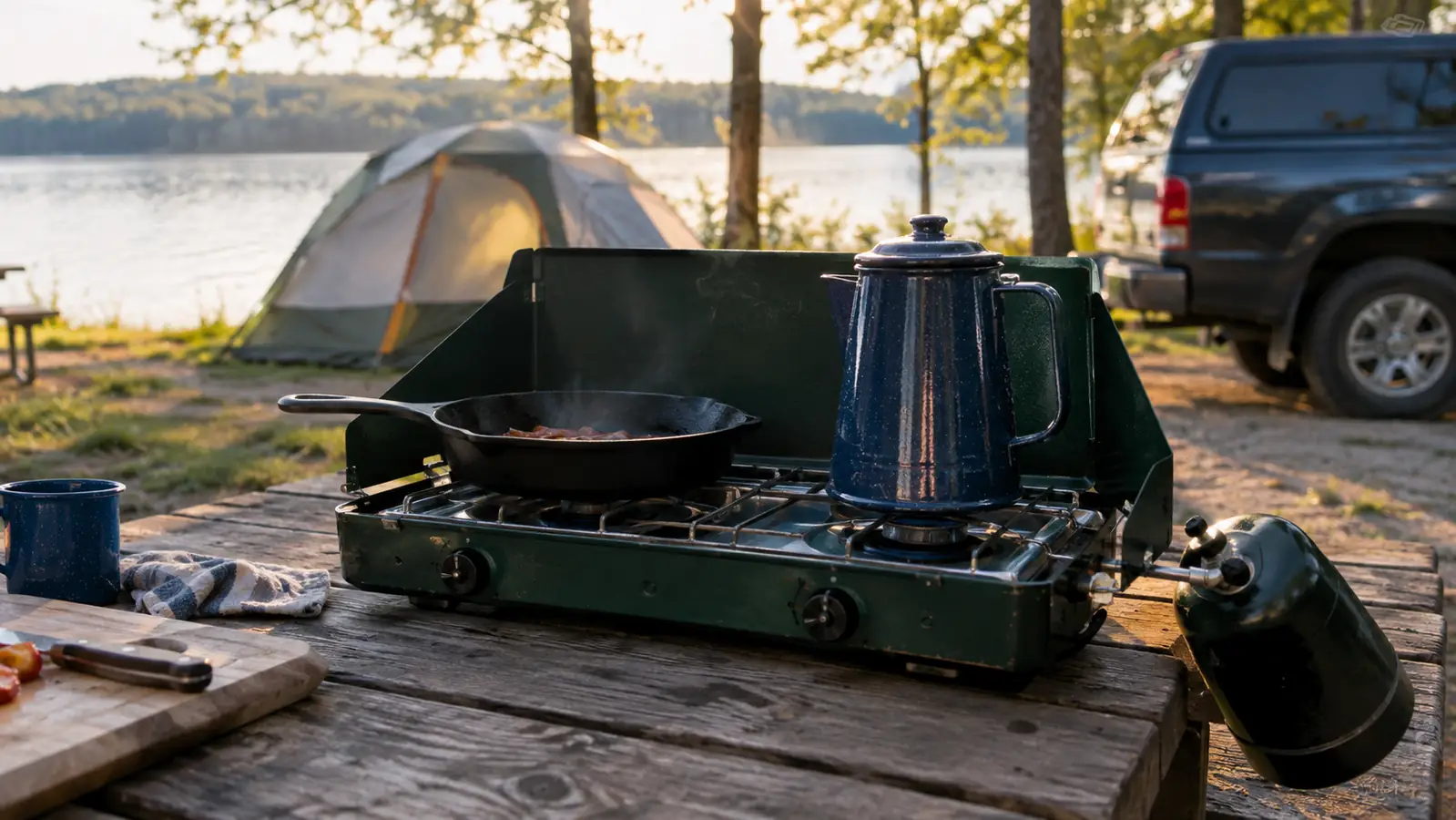
My typical morning was a 10-inch cast iron skillet for bacon and eggs on the left burner and a percolator on the right. The left burner is rated at 11,000 BTUs and the right at 9,000, so I learned to put the skillet on the left and the coffee on the right. That is the kind of detail you only notice after a few trips, and it is worth knowing before you buy. On the mornings when Marla wanted pancakes instead of eggs, I set the griddle across both burners and kept the flame on the left burner a notch lower than the right. It took me three tries to figure out that the left side runs hotter, and after that the pancakes came out the same color on both sides.
I also used it for dinner most nights: burgers, foil packets of potatoes and onions, and one memorable batch of chili that simmered for an hour while we sat in camp chairs watching the lake. The stove never sputtered, never flamed out, and never needed more than a quarter turn to light. That is more than I can say for the two-burner stove I used in the 1980s, which needed a match and a prayer. That old stove had a habit of flaring up when the grease hit the drip tray, and I spent more time babysitting it than I did cooking. The Coleman Triton does not do that. The flame stays where you set it, and the drip tray slides out and rinses clean in about a minute.
What the Coleman Triton Gets Right
The first thing you notice is the wind protection. The Triton has three-sided wind guards that fold up around the burners, and they make a real difference. At Perry Lake in May, we had a steady 15 mph wind off the water. My old stove would have taken twice as long to boil water and the flame would have danced all over the place. The Triton held a steady blue flame and had water boiling in about four minutes. That is the single biggest reason I would recommend it to anyone who camps near lakes or in open fields. I tested it once with the guards down just to see the difference, and the boil time stretched to nearly seven minutes with the same wind. Those guards are doing real work.
The second thing is the heat output. 11,000 BTUs on the main burner is genuinely hot. I could get a cast iron skillet screaming hot for searing burgers, and I could also turn it down to a low simmer for chili without the flame sputtering. That range of control is what separates a good camp stove from a frustrating one. The knobs are on the sides, which sounds like a small thing, but it means you are not reaching over the flames to adjust the heat. After a season of use, I consider that a safety feature as much as a convenience. When I was a kid, my dad's stove had the knobs on the front, and I still remember the singed sleeve I got reaching across a hot burner to turn down the flame.
The third thing is the build. The Triton has a chrome-plated grate and a body that feels like it will take a beating. I am not gentle with gear. It rides in the bed of my 2014 Tacoma under a cap, and it has been rained on, baked in the sun, and covered in bacon grease more times than I can count. The paint has not chipped, the legs have not bent, and the latch that holds it closed still clicks shut like it did in April. Coleman has been making camp stoves for a long time, and the Triton feels like the result of all those years of knowing what breaks. I have owned Coleman gear since the 1980s, and this stove is the first one that has not needed a single repair or replacement part in a full season.
Where It Falls Short
The griddle that comes with the Triton is the weakest part of the package. It is a thin, non-stick griddle that does not heat evenly on the two burners. The left side gets noticeably hotter than the right, which means pancakes cook unevenly unless you rotate them. I used it twice and then switched to my cast iron skillet for everything. If you buy the Triton, plan on using your own cookware. The griddle is not a reason to buy this stove, and it is not a reason to avoid it either. It is just there. I keep mine in the bottom of the storage bag in case I ever need a flat surface, but it has not been on the stove since May.
The second shortcoming is the size and weight. The Triton is not a backpacking stove. It is a car camping stove, and it knows it. It weighs about 12 pounds and folds up to roughly 20 by 18 by 4 inches. That is fine for the bed of my Tacoma, but if you are planning to carry it any distance, you will feel it. I would not want to hike it in anywhere. This is a stove for people who drive to the campsite, and it does not pretend to be anything else. I carried it from the truck to the table maybe 30 times this season, and even that short walk is enough to remind you it is not a lightweight piece of gear.
The third thing is the regulator. The Triton uses a standard propane cylinder connection, and the regulator is built into the stove. That is normal for this class of stove, but it means you cannot use a bulk propane tank without an adapter hose. I bought an adapter hose for a 20-pound tank and it worked fine, but the stove does not come with one. If you camp a lot, you will probably want to buy the hose. It is a small extra cost, but it is worth knowing about before you buy. I ran the stove off the 20-pound tank for the last three trips of the season, and it behaved exactly the same as it did on the little green cylinders.
The wind guards are not a gimmick. At Perry Lake in a steady 15 mph wind, the Triton boiled water in about four minutes while my old stove would have taken twice as long.
How It Performed Over a Full Season
I kept a rough log of how the Triton performed across the season. The first trip was in April at Clinton Lake, where the overnight low hit 38 degrees. The stove lit on the first try in the cold, which is not something every propane stove does. The flame was steady and the coffee was hot. The last trip was in October at Lake of the Ozarks, and the stove performed exactly the same. No drift in performance, no parts that worked loose, no rust on the grate. I checked the burner ports with a flashlight at the end of the season, and they were clear. That is the kind of thing that tells you a stove was built to last.
I went through about 12 propane cylinders over the season. That is roughly one cylinder per trip, which includes cooking breakfast and dinner most days. A 16.4-ounce cylinder gives me about two hours of cooking on medium heat, which is about what Coleman claims. If you cook three meals a day, you will go through a cylinder faster, but for our routine, one cylinder per trip was the norm. On the Colorado trip, where the altitude made everything take a little longer, I used a cylinder and a half over six days. The stove handled the altitude fine, which surprised me, because I have had other propane appliances get lazy up there.
The one thing I watched closely was the regulator. I have had regulators fail on other stoves, usually after a season or two, and the failure mode is always the same: the flame gets weak and yellow, and the stove will not get hot. The Triton's regulator never did that. At the end of October, the stove still lit instantly and burned as clean as it did in April. That is the kind of durability I care about, because a stove that fails on a cold morning is not a minor inconvenience. It is the difference between a good trip and a bad one. I have been on trips where the stove died on day two and we ate cold cereal for the rest of the week. The Coleman Triton never came close to doing that.
Who This Is For
The Coleman Triton is for people who drive to the campsite and cook real food. If you are a car camper, a family camper, or someone who spends weekends at state parks and lake campgrounds, this stove will do everything you need. It is powerful enough for a cast iron skillet, stable enough for a percolator, and the wind guards make it usable in conditions that would frustrate a cheaper stove. Marla and I cooked every meal on it for a full season, and neither of us ever wished we had brought a different stove. If you camp the way we do, out of a truck with a bed cap, this is about as close to a kitchen as you are going to get at a campsite.
Who Should Skip It
Skip the Triton if you are a backpacker. At 12 pounds, it is far too heavy to carry any distance, and there are much lighter options if you are hiking to camp. Skip it if you only boil water for freeze-dried meals, because a single-burner stove will do that job with less weight and less bulk. And if you are the kind of cook who needs precise low-temperature control, the Triton's simmer is good but not great. It will hold a gentle bubble for chili, but it is not a replacement for a kitchen stove. For everyone else, it is the stove I would buy again. I have already told two neighbors at the campground about it, and one of them bought one before the season was over.
What I Liked
- Wind guards actually work in steady wind
- Main burner puts out real heat for searing
- Knobs on the side keep your hands away from the flames
- Folds up compact and rides well in a truck bed
- Regulator held up through a full season without fading
Where It Falls Short
- Included griddle heats unevenly and is not worth much
- Heavy for anything but car camping
- No adapter hose for bulk propane tanks included
The stove I cooked 14 trips' worth of breakfasts on
The Coleman Triton earned its place in the bed of my Tacoma. If you want a two-burner stove that handles wind, heats fast, and holds up, this is the one.
Amazon Check Today's Price on Amazon →