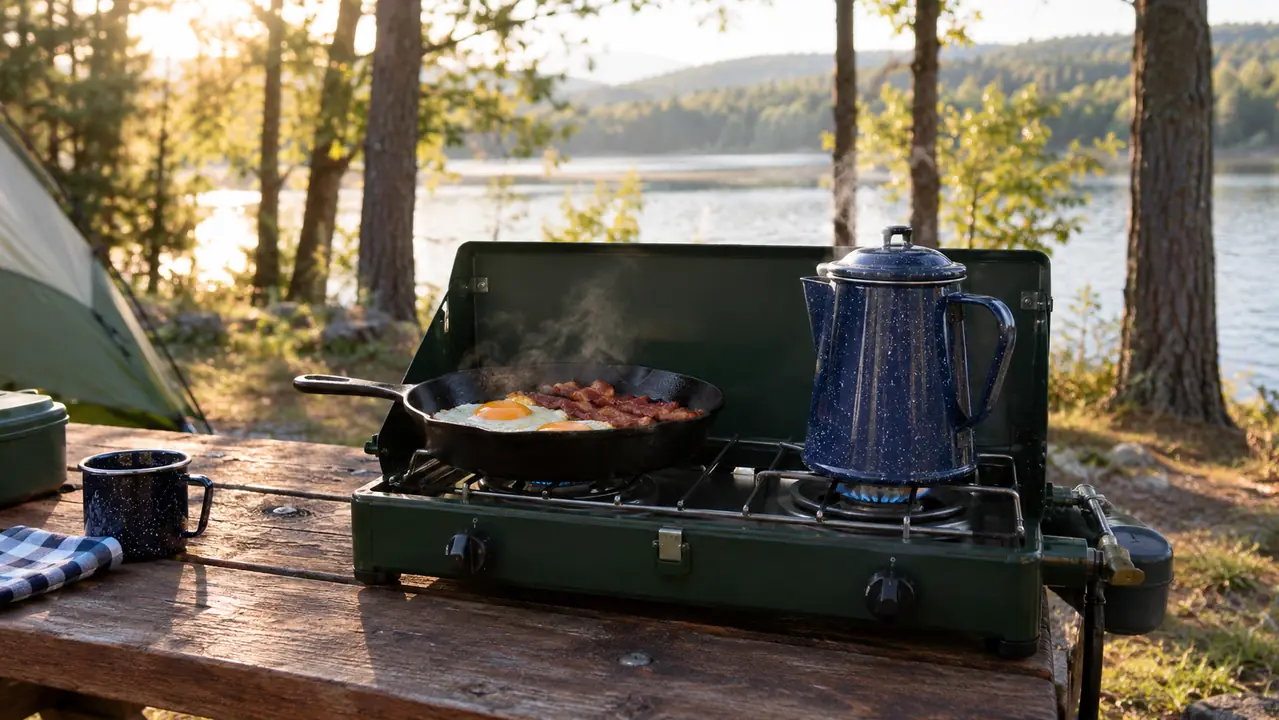
If you've ever tried to make breakfast for two on a single-burner stove, you already know the problem. The coffee has to wait while the bacon cooks. The bacon has to come off before the eggs go on. By the time everything is ready, the first thing you made is cold, and you're eating your camp breakfast in shifts. I did that for years. Then I bought a two-burner Coleman stove and learned that a full breakfast at the campsite is less about fancy cooking and more about a simple order of operations.
My name is Curt Ballard. I'm 59, I live in Olathe, Kansas, and I've camped since I was a kid. My wife Marla and I get out most months from April through October, usually to Clinton Lake or Perry Lake here in Kansas, down to the Lake of the Ozarks or Mark Twain National Forest in Missouri, and one longer trip west every summer. We cook a full breakfast most mornings on the trip. This is the routine that works for us on a Coleman Triton 2-burner propane stove, and it works whether we're feeding just the two of us or a whole campsite.
Start with a stove that holds a steady flame in a morning breeze
The Coleman Triton 2-Burner Propane Stove is the one I've used for years. It has enough room for a 12-inch skillet and a coffee pot at the same time, and the wind guards make a real difference at a lake campsite.
Amazon Check Today's Price on Amazon →Step 1: Get the layout right before you light anything
The biggest mistake people make with a two-burner camp stove is treating it like a kitchen range. They set it up on the ground, or on a wobbly table, and then wonder why the pan slides and the flame flickers. Set the stove on the flattest, most stable surface you can find. At most state park campsites that's the picnic table. I put a folding table next to it for the food, the plates, and the paper towels, so I'm not reaching across a hot stove to grab a spatula.
Before I light anything, I get everything out of the cooler and lined up: eggs, bacon, potatoes if we're having them, butter, salt, pepper, and the coffee. I fill the coffee pot with water and set it near the stove. I put a plate with a paper towel on it next to the stove for the cooked bacon. Once the fire is on, I don't want to be digging through the cooler with raw egg on my hands. That's the whole trick. Ten minutes of setup saves you twenty minutes of juggling.
On the Coleman Triton, the two burners are side by side, which matters more than you'd think. A lot of cheap two-burner stoves squeeze the burners together so close that a 12-inch skillet hangs over the edge. The Triton has enough spacing that I can run a 12-inch cast iron skillet on the left and a standard coffee pot on the right without anything overlapping. If you're buying a stove for camp breakfasts, check the burner spacing before you buy. That single detail makes the whole routine easier.
Step 2: Start the bacon first, then get the coffee going
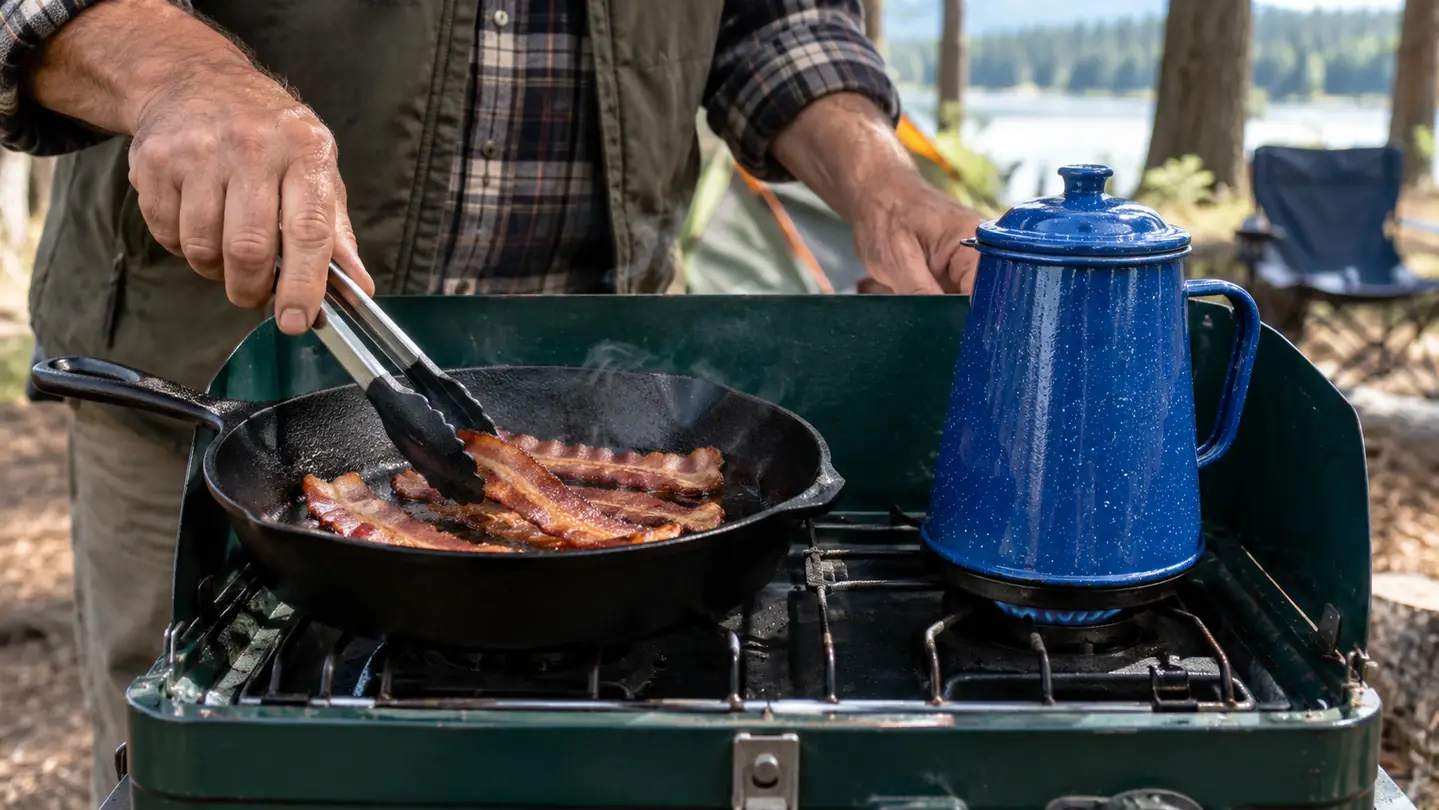
Bacon takes the longest and it's the most forgiving, so it goes on first. I put the cast iron skillet on the left burner over medium heat. Not high. High heat burns the bacon and fills the whole campsite with smoke. Medium heat renders the fat slowly and gives you bacon that's crisp without being brittle. I lay the strips in the pan and give them a couple of minutes per side. If the morning is windy, the wind guards on the Triton earn their keep here. They block enough breeze that the flame doesn't gutter out on the open side.
While the bacon cooks, I put the coffee pot on the right burner over medium-high heat. This is the moment the two-burner stove earns its place in the camp kit. On a single burner, you choose between bacon and coffee. On a two-burner, you get both at once, and by the time the bacon is done, the coffee is ready. If you like your coffee strong, start it just after the bacon so it has more time to steep. If you're in a hurry, start them together.
When the bacon is done, I move it to the paper-towel plate and pour most of the bacon fat into a small heat-safe container. I leave a thin coating in the pan. That fat is about to do double duty as the cooking fat for the eggs. No need to add butter. The bacon flavor carries through, and it saves you from carrying a separate bottle of oil for breakfast.
Step 3: Cook the eggs in the bacon fat while the coffee finishes
With the bacon resting and the coffee nearly done, the left burner is free for the eggs. I crack four eggs straight into the still-warm skillet with the bacon fat over medium-low heat. Medium-low is the key. Eggs cook gently and stay tender. High heat gives you rubbery edges and a skillet that's a pain to clean. I season them with a little salt and pepper and let them sit until the whites are set, then I flip them once for over-easy. If Marla wants scrambled, I stir them slowly with a silicone spatula and pull them off just before they look done, because they keep cooking in the pan.
If we're having potatoes, this is where the two burners really shine. I dice the potatoes ahead of time at home and keep them in a zip bag in the cooler. When the eggs come off, I move the potatoes to the left burner and let them crisp in the remaining bacon fat while the coffee pot finishes on the right. Potatoes take about fifteen minutes over medium heat. The trick is to leave them alone for a few minutes at a time so they get a brown crust instead of steaming. Stir, then let them sit. Stir, then let them sit.
The Coleman Triton handles this well because each burner has its own control and the flame holds steady. I've used stoves where the flame surges when the wind shifts, and that's how you get eggs that are brown on one side and runny on the other. The Triton has been predictable for me across years of trips to Clinton Lake, Perry Lake, and the Ozarks. Predictable heat is the whole game in camp cooking.
Step 4: Use both burners for the sides and the toast
Once the eggs are done and resting on the plates, I put a small griddle or a second skillet on the right burner for the toast. The coffee pot comes off, the toast goes on. This is the part people forget: a two-burner stove is not just for two things at once. It's for sequencing two things so that nothing sits and gets cold. The eggs stay warm on the plate under a foil tent while the toast browns on the right burner. The coffee stays hot in the pot on the table. Everything lands on the table at the same time.
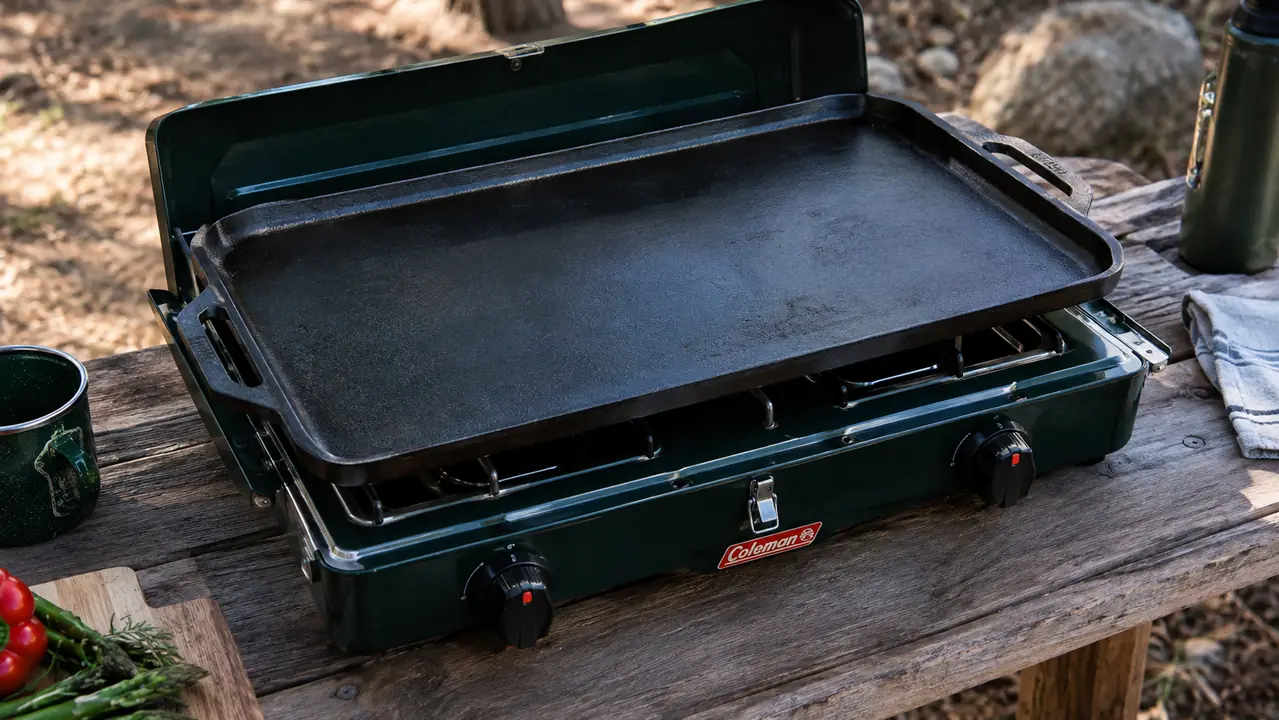
If we're cooking for more than two, I use a cast iron griddle that spans both burners. That turns the Coleman Triton into one big flat cooking surface, which is the fastest way to feed four or five people. Bacon on one half, eggs on the other, and the middle stays warm. A griddle like that is worth carrying if you regularly camp with family or friends. It also makes cleanup simpler, since you're scrubbing one flat surface instead of two pans.
Step 5: Clean up before you eat, or at least before you leave
The fastest way to ruin a good camp breakfast is to come back from a hike to a skillet full of dried egg. I pour a cup of water into the hot skillet right after the food comes out and let it sit while we eat. The heat loosens everything, and by the time breakfast is over, a paper towel wipes it clean. I do the same with the griddle. Hot water and a paper towel handle ninety percent of camp cookware. Soap is a last resort, and only if the pan really needs it.
I also shut off the propane tank at the stove before I walk away, even if I'm coming back in ten minutes. The Coleman Triton connects to a standard 16.4-ounce propane cylinder, and the valve is easy to reach. I turn the tank off, then turn both burner knobs to off to bleed the line. That habit has kept me from coming back to an empty tank in the middle of a trip. If you use the green disposable cylinders, take the empty one home and recycle it properly. Do not leave it at the campsite.
One more cleanup note: let the stove cool completely before you close the lid. The Triton's lid doubles as a carry case, and closing it while the burners are still warm traps heat and moisture. I leave the stove open on the table while we eat, then close it and strap it before we head out. That little pause keeps the stove smelling like a stove instead of like last week's bacon.
What Else Helps
A good stove is only part of the breakfast system. I carry a 12-inch cast iron skillet, a small coffee pot, a silicone spatula, and a set of long tongs. The tongs are for the bacon. The spatula is for the eggs. A folding table next to the stove gives you a place to put the food, the plates, and the coffee without reaching across the burners. If you're buying one thing to improve your camp breakfast, get a decent cast iron skillet and learn how to use it. It heats evenly, holds heat in the wind, and cleans up with hot water and a paper towel.
I also bring a small bottle of dish soap and a wash tub, even though I mostly use hot water. And I carry an extra propane cylinder on every trip, because running out of fuel at breakfast time is a ten-dollar mistake that costs you an hour. The Coleman Triton sips fuel on low, but a full breakfast with coffee will use a noticeable amount of a 16.4-ounce cylinder. I swap in a fresh cylinder when the stove starts to feel weak, which is usually on the second or third morning of a trip.
The whole trick to a camp breakfast is the order of operations. Bacon first, coffee alongside, eggs in the bacon fat, and everything lands on the table at the same time.
How the Coleman Triton Fits Into This Routine
I've been using the Coleman Triton 2-Burner Propane Stove for years, and it has held up to a lot of abuse. It has been rained on, packed in the bed of my 2014 Tacoma under a pile of gear, and used on picnic tables from Kansas to Colorado. The burners still light on the first click, and the wind guards have never bent out of shape. For a camp stove, that's a long life. I've had cheaper stoves where the igniter died in a season and the burners rusted by year two. The Triton is built like the Coleman stoves I remember from camping as a kid, which is to say it's simple and it lasts.
The controls are straightforward, which matters when your hands are cold and you're holding a cup of coffee. Each burner has a push-and-turn knob that lights the burner with a built-in piezo igniter. I don't need a lighter or a match. The heat output is enough for a full breakfast. I run the left burner on medium for bacon and eggs, and the right burner on medium-high for coffee. The stove has enough output that I've also used it to boil water for pour-over coffee and to keep a pot of chili warm in the evening. It's a workhorse, not a specialty tool.
The only real limitation is the propane cylinder. The stove runs on the standard 16.4-ounce green bottles, which are easy to find but not the cheapest fuel per meal. A full breakfast for two with coffee uses maybe a third of a cylinder across a four-day trip if I also use the stove for dinner. I plan for that by carrying one spare cylinder and refilling at a hardware store when I pass through town. If you want to skip the disposable bottles entirely, a propane refill adapter and a 5-pound tank sit nicely on the tailgate of the Tacoma, and the stove hooks right up with the included hose. That setup costs more up front but pays off over a season of weekend trips.
The same stove, morning after morning
A full breakfast on a two-burner stove comes down to steady heat and a simple routine. The Coleman Triton has given me both for years, and it's still the first thing I pack for a camping trip.
Amazon Check Today's Price on Amazon →